
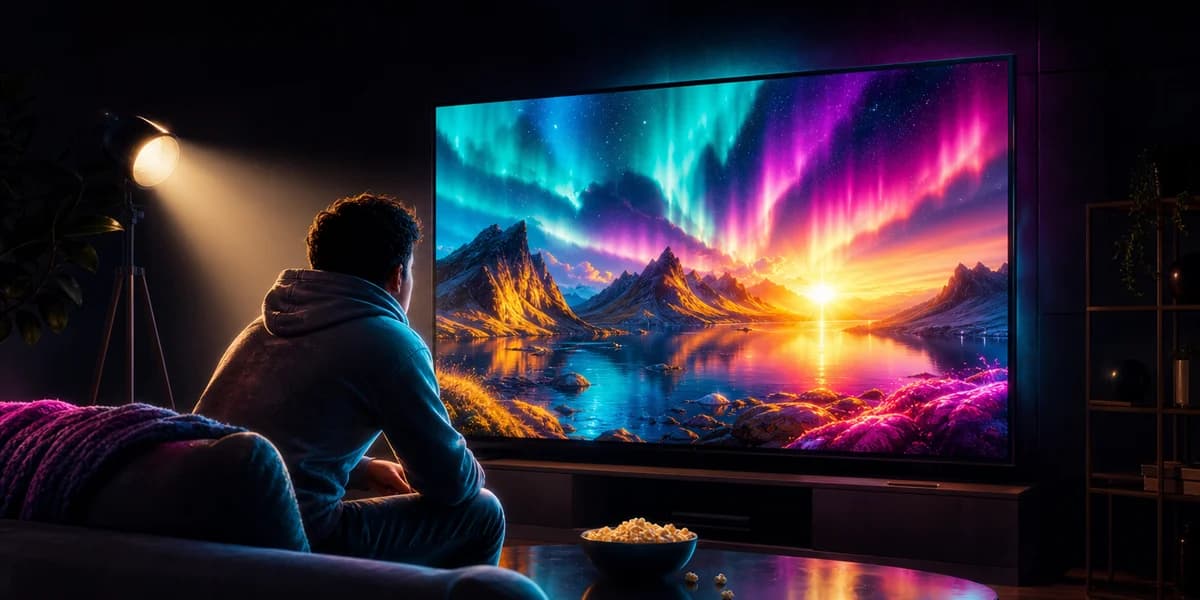

HDR (High Dynamic Range)
Enhanced color and contrast with High Dynamic Range technology, delivering more realistic and vibrant images.
Best services for HDR (High Dynamic Range)
- Netflix
Netflix Premium
Score 9/10
£20.99/mo
Netflix Premium offers excellent HDR implementation with both HDR10 and advanced HDR formats support. The service has one of the largest libraries of HDR content, including thousands of titles across Netflix Originals, movies, and TV series. Technical quality is consistently high with excellent bitrates and encoding. HDR content is well-integrated into the platform with clear labeling and reliable streaming across compatible devices.
- Amazon Prime Video
Apple TV
Score 8/10
£8.99/mo
This Apple TV add-on through Amazon Prime provides excellent HDR implementation with strong technical quality and extensive content availability. Apple TV+ content is produced with high-end HDR standards, offering vibrant colors and enhanced contrast across their original programming. The technical implementation is industry-leading with consistent quality across compatible devices. Content library includes hundreds of HDR-enabled shows and movies, though smaller than Netflix's catalog. User experience is seamless with automatic HDR detection and excellent streaming reliability.
- Apple TV
Apple TV
Score 8/10
£9.99/mo
Apple TV+ delivers excellent technical HDR quality with superior encoding and streaming reliability. All original content is produced and delivered in HDR format with exceptional visual quality. However, the content library is significantly smaller than competitors, consisting primarily of Apple's original programming. The HDR implementation is industry-leading in quality but limited in quantity.
Guide to HDR (High Dynamic Range)
HDR (High Dynamic Range) is a picture technology that makes streamed content look noticeably more lifelike and vivid. Here is what it means in plain terms.
What HDR actually does
HDR introduces a wider range of colours and brightness levels compared to Standard Dynamic Range (SDR), telling your TV exactly which colours to display at the correct level of brightness. SDR, by contrast, has a limited range of brightness and colours, so images tend to look duller and less sharp.
The key improvement is in luminance - the measure of how bright a screen can get, expressed in 'nits'. Standard SDR tops out at around 100 nits, whereas HDR content is mastered at 1,000 nits or more. That gap means brighter highlights, deeper blacks, and far more detail in both the darkest and lightest parts of a scene - the kind of nuance that makes a sunset look like a sunset rather than a washed-out blob of orange.
In practical terms, HDR-enabled content played on an HDR-compatible TV produces a noticeably fuller, richer, and more realistic image compared to SDR. Black levels appear much deeper and retain fine detail, while the colour spectrum is broader and closer to what the human eye sees naturally.
The different HDR formats
There are a few HDR formats you may come across:
- HDR10 - the most widespread format, supported by virtually all media including streaming services. It uses static settings applied across an entire film or programme.
- HDR10+ - a step up, capable of up to 4,000 nits of peak brightness. It uses dynamic metadata, meaning picture quality is calibrated on a frame-by-frame basis rather than set once for the whole title.
- Dolby Vision - a proprietary format that also uses dynamic metadata for scene-by-scene adjustments, and can help cheaper TVs display HDR content more accurately through improved tone-mapping.
- HLG (Hybrid Log Gamma) - a hybrid format used primarily by broadcast services, combining SDR and HDR into one signal.
Where to watch HDR content in the UK
Major UK streaming services including Netflix and Amazon Prime Video carry HDR content. Netflix HDR is available on its Ultra HD plan (currently £17.99 per month in the UK). Amazon Prime Video carries content in HDR10, HDR10+, and Dolby Vision. To stream 4K HDR smoothly, Amazon recommends a broadband speed of at least 15 Mbps.
What you need at home
To get the benefit of HDR, you need two things: an HDR-compatible TV and HDR-encoded content. If your TV cannot display HDR, the picture will still play - it just will not look any different from standard HD. A TV capable of at least 500-600 nits of peak brightness is a good starting point for seeing a meaningful HDR improvement.
Services offering HDR (High Dynamic Range)
Related Audio/Video Quality features
About Audio/Video Quality
Features related to video resolution, audio quality, and technical streaming capabilities
View all Audio/Video Quality features